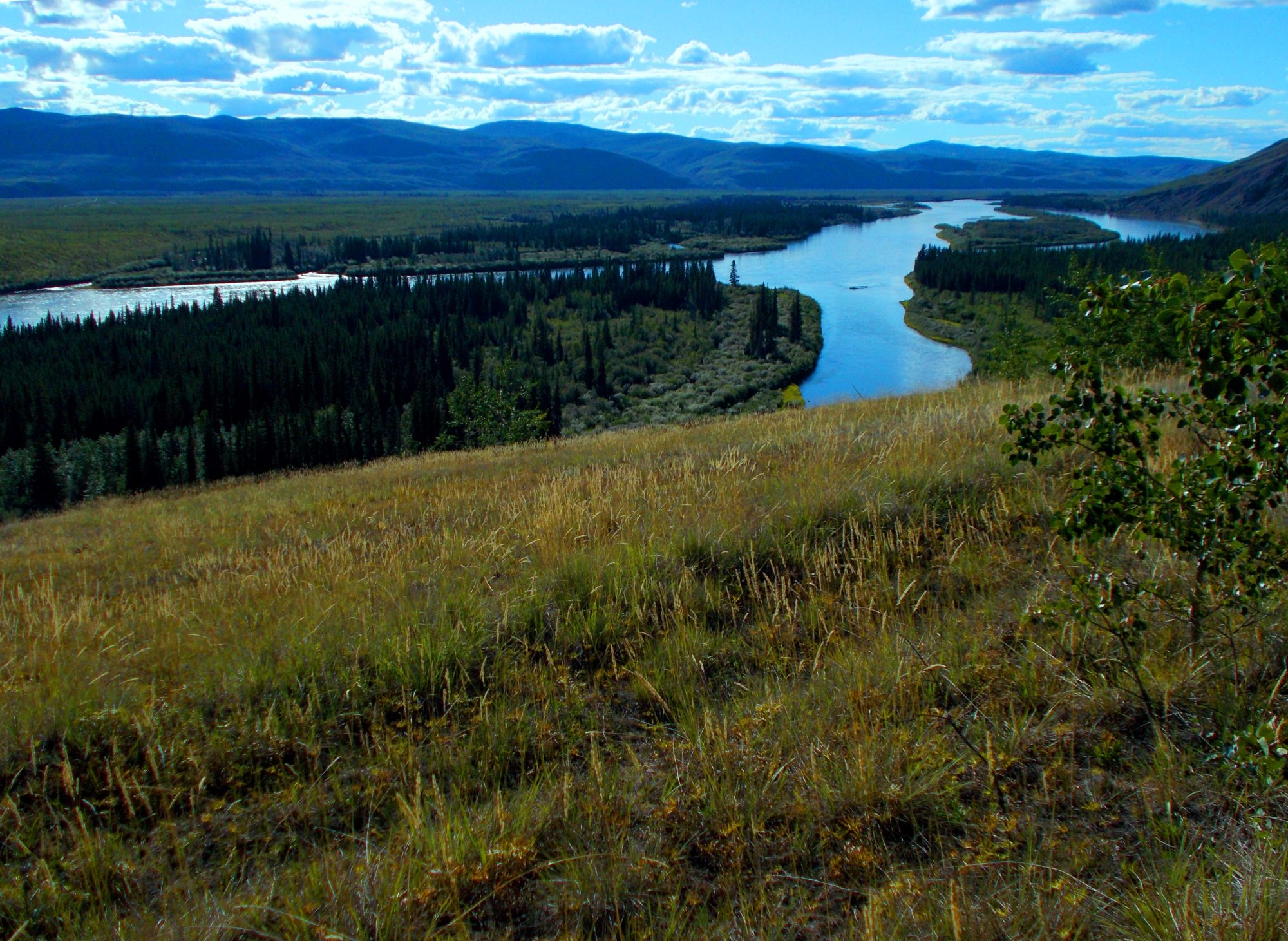
The Swinehart Farm – part 4 (The Family Reunites; End of the Farm, 1901-1914)

The Swinehart Farm – part 4

The family reunites (1901 – 1911)

The establishment of the Swinehart Farm at Fort Selkirk may have provided the stable base to bring William Swinehart and his children back together again.  William and his wife Rhoda had been raising their children in a settled life in rural Wisconsin when Rhoda died in 1889. In 1896, the family’s lives began to change even more dramatically when William and his son Guy went off to Juneau, Alaska. The older daughters Leta and Vivian followed sometime later and attended school in Juneau, with the youngest daughter Rhoda remaining behind in Wisconsin. This meant that the family was spread out between Wisconsin, Alaska and the Yukon during the last part of the 1890’s.

Leta returned to Wisconsin from Juneau at some point before 1900, but Vivian remained in Juneau and spent her middle teenage years separated from her family at the Sisters of St. Ann boarding school. In March of 1901, three years after William and Guy Swinehart had departed Juneau, Leta and Vivian, then aged 21 and 16, joined him at his Fort Selkirk farm.

The likely scenario for the young ladies’ trip to Fort Selkirk would have been an adventure, particularly for Leta. She presumably travelled by train from Wisconsin to Seattle, then by steamship to Juneau, where she met Vivian. The two would have journeyed together by boat to Skagway, boarded a train to Whitehorse on the newly-built White Pass & Yukon Route, then travelled on a riverboat down the Yukon River to Fort Selkirk to reunite with their father William, brother Guy and uncle Ham Kline.

Leta and Vivian eventually found husbands in Fort Selkirk. Newspapers in both Dawson and Juneau reported on Leta’s marriage at the Swinehart Farm on April 3, 1904 to Sgt. Edward Stillman of the North-West Mounted Police (NWMP). In October 1905, Vivian was married to George McLachlan, the telegraph operator at Fort Selkirk.

In 1905, Edward Stillman was charged by his employer, the NWMP, for selling government hay and then attempting to cover up his deed. He was dismissed from the force, which may have caused he and Leta to move to Dawson City, where in 1908 he was working as a timekeeper for the Guggenheim mining syndicate. In 1911 Vivian and her husband George McLachlan also moved from Fort Selkirk to Dawson City when George became a telegraph operator there.

In June 1908, the Swineharts became involved in one of the Yukon’s more notorious murder cases, that of Ned Elfors. About 20 kilometers downstream of Fort Selkirk, Elfors shot one travel companion in cold blood and severely wounded the other, Emil Anderson, who managed to escape. Anderson found his way to the Selkirk cut-off road, on which he encountered William Swinehart not far from his farm. Swinehart brought Anderson to his daughter Leta Stillman’s house in Fort Selkirk, where Leta and her sister Vivian McLachlan dressed his wounds. Elfors was captured soon after, and William, Leta and Vivian all had to travel to Dawson City to testify at his trial the following month.

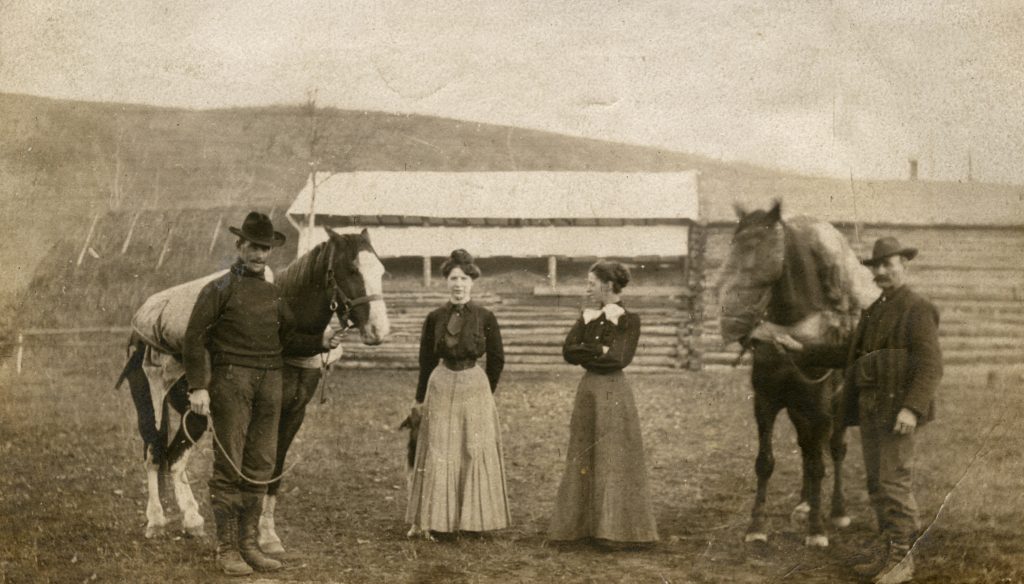
Also in June 1908, a somewhat lighter story appeared in the Dawson Daily News when seeds William Swinehart had ordered from Toronto did not arrive as expected.  A letter of complaint he wrote to the post office appeared in the News, containing this amusing note: “one Toronto firm was filling orders through the mail all winter. Why, my daughters have been getting goods from that firm all winter. They have had two hats each this spring from Eaton’s”. Apparently even pioneer Yukon farming women require nice hats, and these may be ones that are in photographs of the Swinehart daughters at Fort Selkirk.

In early 1910, William Swinehart’s youngest daughter Rhoda, who had been left behind in Wisconsin with her grandparents, made the family complete by travelling to Fort Selkirk in a journey likely similar to that undertaken by Leta nine years previous. Rhoda appears to have made the trip alone, a 21-year old farm girl from Wisconsin travelling to the frontier of the Yukon. It is possible that she was seeing her father, brother and sisters for the first time in several years.

In the 1911 Canada Census, all of William Swinehart’s family, including his son and three daughters, one son-in-law and a future son-in-law, were shown to be present at the Fort Selkirk farm. Whether it was one big happy family is uncertain, but they were soon to start drifting apart once again.

The year after her arrival at Fort Selkirk, Rhoda married Alfred Ingrams from Montreal in July 1911. Her sisters Leta and Vivian, then living in Dawson City but in Fort Selkirk when the census was taken, were perhaps there preparing for Rhoda’s wedding. Within a week of the wedding, Alfred and Rhoda were already on their way out of the Yukon, bound for the Fraser Valley of British Columbia where they became engaged in berry farming.
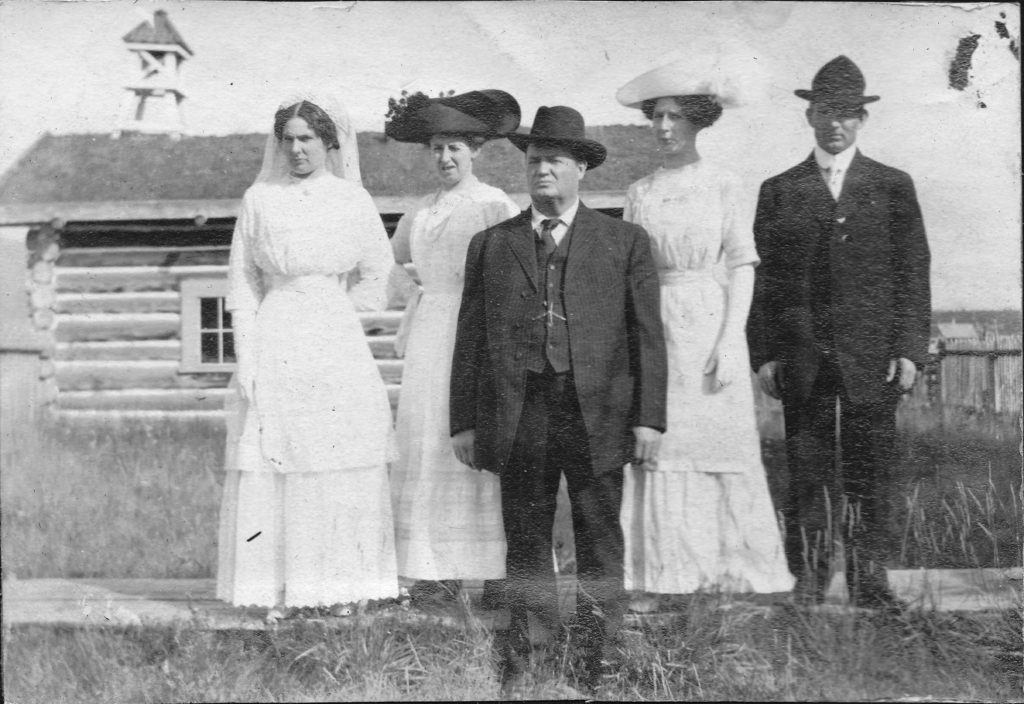
Rhoda Swinehart’s wedding at Fort Selkirk, July 26, 1911. She is standing at left next to her sisters Leta and Vivian and brother Guy. Her father William stands in front.  In the rear is the Anglican schoolhouse.      (Heather & David Ingrams collection)

In March 1912 in Dawson City, Leta gave birth to a daughter that she and Edward named Vivian Rhoda Stillman, after her two sisters. This was William Swinehart’s first grandchild and the only one he would ever be able to see.

End of the Swinehart Farm (1914) and life in the Yukon (1920’s)

In July 1914, the Swinehart Farm came to a crashing end when William Swinehart dropped dead at the age of 59 while working in his field. The cause was reported by newspapers to be heart disease, but it appears as apoplexy (a stroke) on his death registration. He was buried in the Yukon Field Force cemetery at the eastern end of Fort Selkirk. His grave is marked by a wooden headboard that is becoming difficult to read more than 100 years later, and recently his descendants had a brass plaque installed there as a more permanent marker.
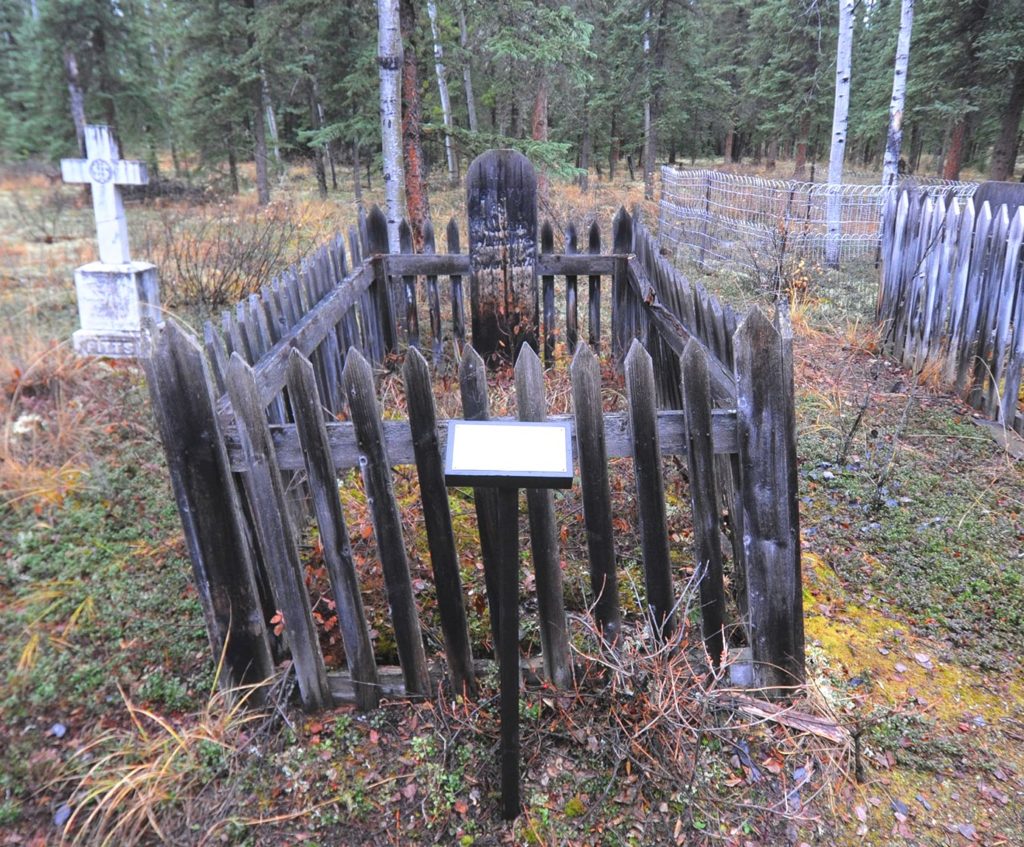
William Swinehart’s 1914 grave at Field Force Cemetery in Fort Selkirk, 2017. The brass plaque was provided by family members in 2017.
(Joel LeBaron photo)

It appears that the Swinehart Farm was abandoned after William’s death. His daughters Leta and Vivian had been living in Dawson City for a few years and his son Guy, who had been at the farm with his father from the start, was also living in Dawson by the following year. Whether the Swinehart Farm was occupied or farmed by anybody afterwards is not certain, but if so it was not mentioned in oral history interviews that were carried out at Fort Selkirk in 1984 and ’85.

The three siblings remained in the Yukon for a few more years before eventually leaving for California. It appears that Vivian was the first to leave after her marriage to George McLachlan ended, and by 1924 she was living in California.

Leta and Edward Stillman had another daughter, Rhoda Jane, born in 1915 in Dawson City, then in 1917 Edward died at the age of 46, leaving Leta a widow with two young daughters. In 1921, Leta married George Pohl in Dawson City in “a wedding remarkable in the history of the Yukon and probably without precedent elsewhere”, in reference to Leta’s and George’s positions in their respective lodges, the Rebekahs and the Oddfellows. The ‘historic wedding’ didn’t make for a long marriage, however, and in 1924 Leta and her daughters left for California.

Guy Swinehart remained the longest in the Yukon, but not for too long after his sisters left.  In 1915, the year after his father died, he was listed as a miner at Dawson City, and also worked that fall as a horse wrangler and big game guide in the upper White River area. In 1916, Guy began working as a telegraph operator, spending most of his telegraph career at Ogilvie (located on the Yukon River upriver from Dawson City), with occasional stints at other stations including Fort Selkirk. The Yukon River break-up of 1925 caused extensive damage and swamped the Ogilvie station, forcing Guy to spend three days on the roof of the office, where he built a fire and subsisted on soda crackers and tea. Guy left the Yukon in that fall of 1925 and by 1927 he was living in California, reunited with his sisters.

The youngest Swinehart daughter, Rhoda, who with her husband Alfred Ingrams had moved from the Yukon to BC in 1911, later moved on to Montreal. After Alfred died there in 1943, Rhoda and her daughter moved to California to join her siblings, who had lived there since the mid-1920’s. They all stayed there for the rest of their days; Guy died in 1949, Leta in 1959, Rhoda in 1964, and Vivian in 1970.

The story of William Swinehart and his children being separated and then reunited at various points during their lifetimes may be an exceptional example of family cohesion, despite circumstances pulling them apart. From Wisconsin to Juneau to Fort Selkirk to California, the Swineharts seemed to continually feel the pull of family bonds throughout their lives.

Updated October 7, 2023
Next:  Part 5 – The Swinehart Farm Today

The Swinehart Farm – part 3 (A Going Concern, 1902-1914)

The Swinehart Farm – Part 3

A Going Concern (1902-1914)

By 1902 the Swinehart Farm was gaining a profile, as information about its place in the Yukon agricultural picture began appearing in newspaper articles and various types of reports. While the reports were relatively objective, the newspaper accounts, in the style typical of reporting at that time, often contained embellishments, errors, and perhaps even concoctions.

A June 1902 article in Dawson City’s Daily Morning Sun reported that “it may not be generally known, but as fine a farm as can be found anywhere is the Swinehart Farm. About forty acres of ground have been under cultivation for two years”. The article also said that “every visitor to the farm is received royally and enjoys himself in every way”.

In April 1903 the Yukon Sun published a rosy article on William Swinehart and his Fort Selkirk farm, reporting that he had 30 acres under cultivation and a large tract of meadow land. He was growing oat hay, “the finest feed that is available for horses”, as well as a large quantity of vegetables for sale to roadhouses and steamboats. In the spring he marketed potatoes in Dawson City, where he could get a good price for them by being three weeks ahead of produce coming from Whitehorse on steamboats, which had to wait for Lake Laberge to become ice-free. The article concluded with: “Mr. Swinehart has his whole family with him on the farm, and says he has as comfortable a home and as profitable a business as any man could reasonably wish for”.

A little over a month later, the same newspaper reported that William Swinehart would be arriving in Dawson by riverboat soon with five tons of potatoes for sale. The article also mentioned that Swinehart “had the distinction of having Prof. John Macoun, the eminent Canadian botanist, declare the potatoes grown on his farm at Selkirk to be the equal of any grown in America”. Macoun, the Dominion Geological Survey naturalist, had examined agricultural products from the Yukon that were sent to an exhibition in Ontario in the fall of 1902 to demonstrate the agricultural potential of the Territory.

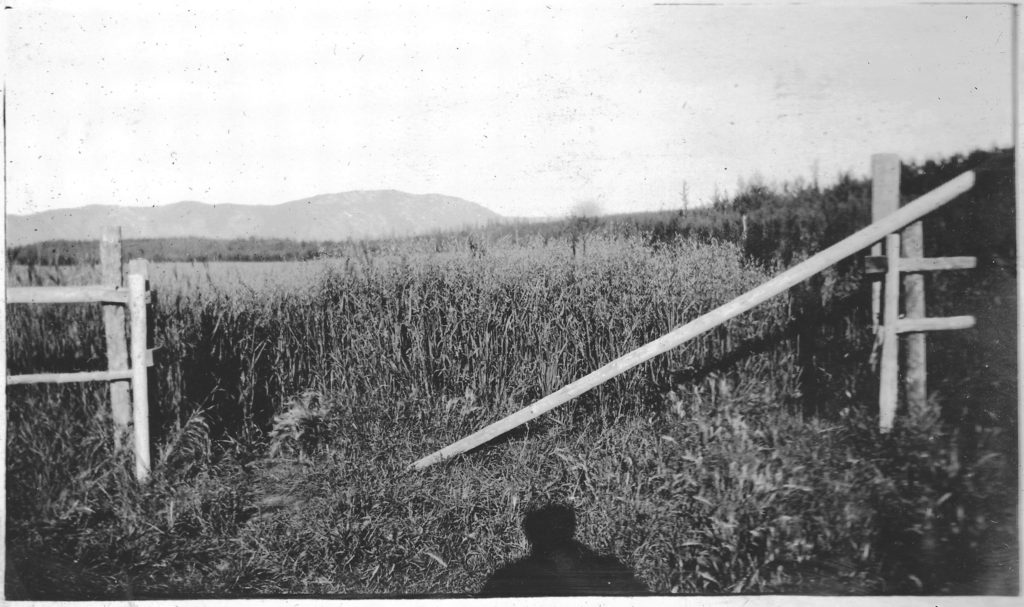
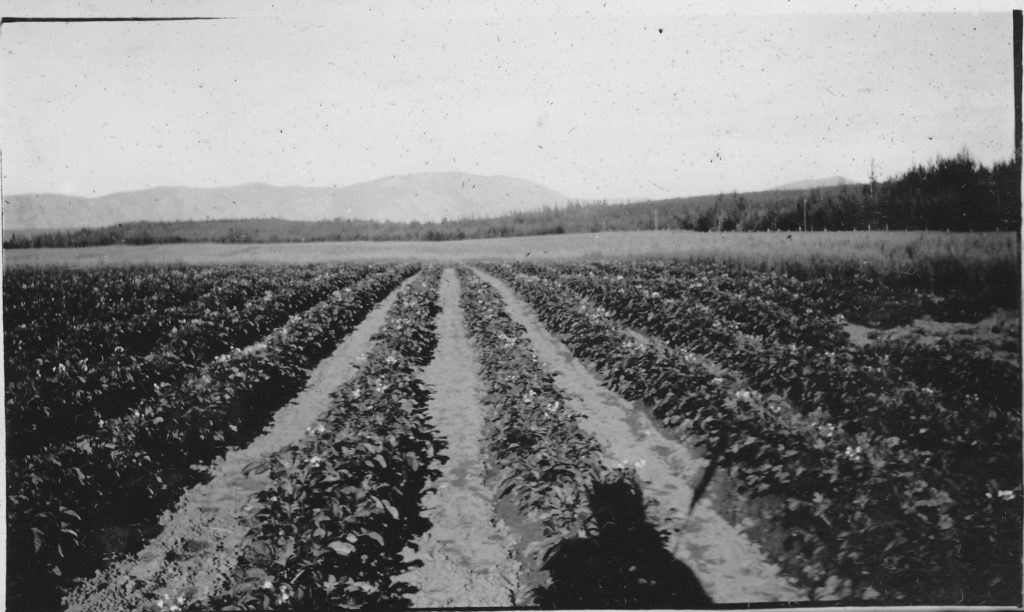
Swinehart Farm potato field, looking east toward Fort Selkirk area
(Heather & David Ingrams collection)

A July 1903 article in the San Francisco Chronicle entitled “Making a Fortune on Klondike Farm” spoke glowingly of Swinehart’s five years as “a successful farmer in the north, becoming an enthusiastic believer in the agricultural possibility of the great Yukon valley”, and having “the most extensive farm in the British Yukon or Alaska”.

In the fall of 1903, Swinehart submitted exhibits to Dawson City’s Horticultural and Industrial Exhibition in the form of “oats five feet tall and heavy with grain, and wheat six feet tall”. The Dawson Daily News reported that “the specimens are among the finest of the kind ever produced in the Yukon”.

Swinehart Farm oat field, looking east
(Heather & David Ingrams collection)

A 1903 report by the Governor of Alaska stated that on two acres the previous year, the Swinehart Farm grew 11 tons of potatoes, nine tons of which were sold within six hours in Dawson City the following spring after the river opened to river transportation. It was noted that the farm’s location was “valuable for the ease and cheapness of reaching a hungry market”.

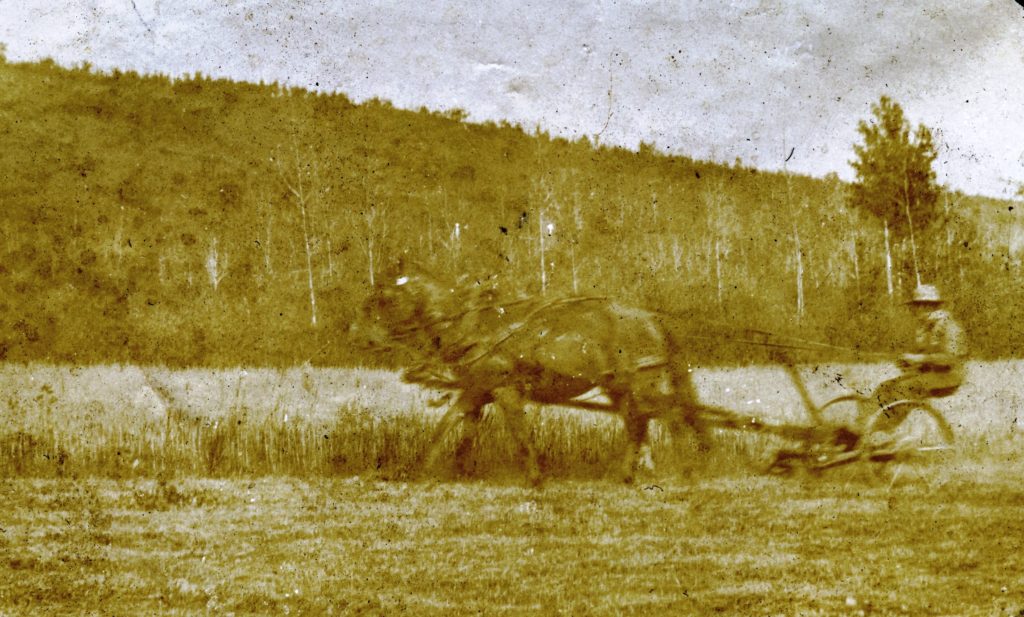
The Spokane Press in October 1905 carried relatively detailed information on the Swinehart Farm operation, the source of which was not stated. The article said that the Swineharts concentrate on field crops such as oats, hay and hardier field vegetables, which can be planted and cultivated with “horse tools”. Oat hay was said to be the chief crop because of the steady demand for it on the Whitehorse-Dawson stage line, which had hundreds of horses to feed. The article concluded by stating that “it is an exceptional season when the Swinehart Farm does not net its owners an income of $10,000”.

Swinehart Farm “horse tools” – cutting oats with a mower
(Susan Coltrin collection)

An excerpt from a 1905 book by John Scudder McLain called Alaska and the Klondike, based on a 1904 trip through the region, says that “one farmer at [Fort Selkirk] is reported to have made a clear profit of $3,000 during the past year on his crops of hay and potatoes”. There can be no doubt that this reference was to the Swinehart Farm. McLain also reported that “his success is said to be encouraging others to seek their fortunes in agriculture at this point”. There may be some truth to this because Fort Selkirk soon became a center of homesteading activity along this section of the Yukon River as well as the lower Pelly River.

In a 1907 newspaper article based on statements by Governor John Brady of Alaska about the agricultural potential of that state, Brady referred to the success of William Swinehart of Fort Selkirk as an example. He said that Swinehart had taken nine tons of potatoes to Dawson City that spring and sold them for $300 per ton. In that same year, the annual report of Alaska Agricultural Experiment Stations made a reference to Fort Selkirk, “which place has been noted for the farming of W.H. Swinehart”. It is evident that William Swinehart’s agricultural endeavors were well known not only within the Yukon, but beyond it as well.

In September 1908 an article in the Dawson Daily News explored the historic and symbiotic relationship between mining and farming; miners need farmers to feed them, and miners give farmers a market. In the article, William Swinehart provided some thoughts about the virtues of farming, outlining why he believed that being a farmer is better than being a miner: “the most independent man on top of earth today is the farmer in Yukon. … one can watch his crop maturing which will bring him more than the average miner gets with all his life-shortening excitement and struggle”.

In truth, however, Swinehart himself tells a somewhat different story. In the years that followed, he along with his son Guy, his sons-in-law, his brother-in-law Ham Kline, and Billy Thompson dabbled in mining in the nearby Selwyn River watershed. They even petitioned the government, unsuccessfully, to assist financially in putting a wagon trail into that area. In the 1914 letter Swinehart wrote to his Wisconsin home town, he stated that “I have been farming here since 1898 with varied success, and would have plenty to spare if I had kept what money I made growing stuff for the gold seekers to eat; but in Rome one does as the Romans do, speculates in gold fields of course”.

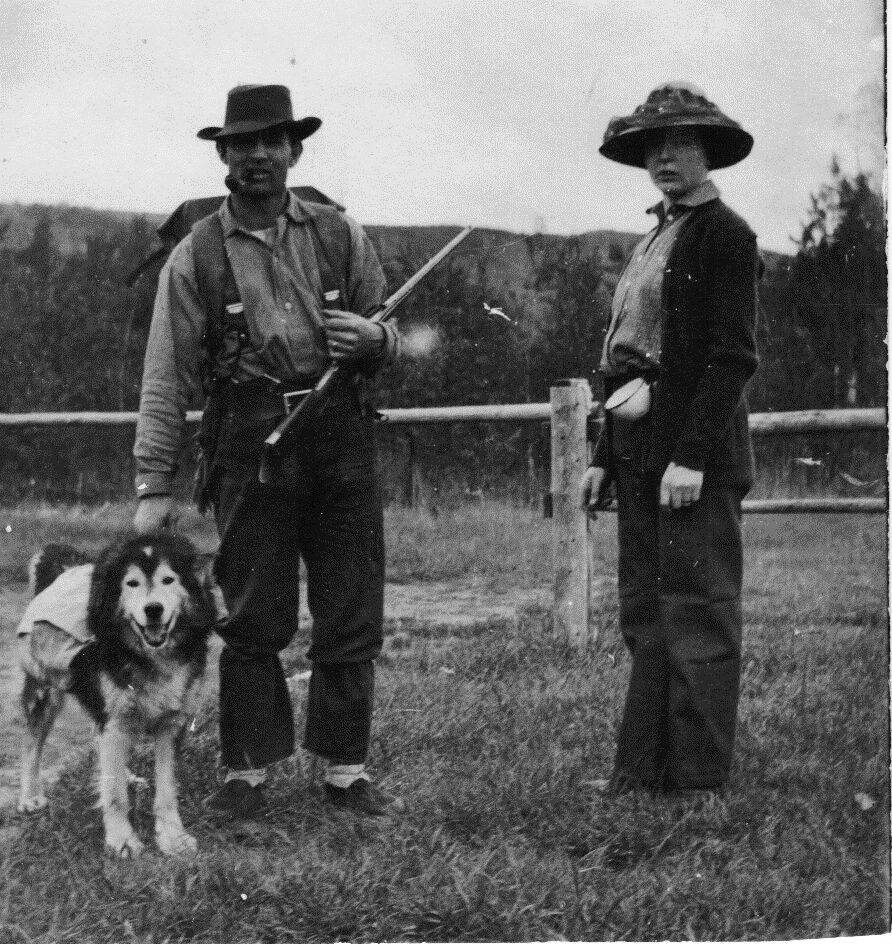
Guy Swinehart and his sister Vivian departing farm on 30-mile hike to mining claim, 1909
(Susan Coltrin collection)

Whatever embellishments or inaccuracies may have been contained in the articles and reports on the Swinehart Farm, it is obvious that William Swinehart and those with him built a successful agricultural enterprise near Fort Selkirk that was capable of sustaining all who were involved in it.

A simple description of the Swinehart Farm operation was perhaps best provided in a letter written in 1974 by a person who had known the farm and family. The letter was sent to Dick and Hugh Bradley of Pelly River Ranch from William Watson, who had been a telegraph operator at Fort Selkirk in 1910-11. The letter included this reference to the Swinehart Farm: “… located about 2 miles out from the main settlement in a valley where they grew almost anything they needed. Had no stock, but went in strong for hay, using horses in the work”.

Swinehart Farm – Vivian Swinehart (woman at left), others unidentified. Hay barn and large haystack behind.
(Susan Coltrin collection)

Updated October 7, 2023

Next:  Part 4 – The Family Reunites; End of the Swinehart Farm (1901-1914)

The Swinehart Farm – part 2 (Establishing the Farm, 1898-1902)

The Swinehart Farm – part 2

Establishing the Swinehart Farm (1898 – 1902)

The Swinehart party’s arrival at Fort Selkirk and beginning the development of the Swinehart Farm added to the swarm of activity that was occurring at Fort Selkirk in 1898 as a result of the Klondike gold rush. The small community until then consisted of not much more than an Anglican church and school, Arthur Harper’s trading post and a few cabins. In the fall of 1898 Fort Selkirk swelled with the arrival of the 200-man Yukon Field Force, along with civilian contractors, and the construction of its complex of buildings. A Northwest Mounted Police post and the Roman Catholic Church were also built in this year. The next year the Yukon Telegraph line came through Fort Selkirk and the Swinehart Farm, bringing more activity and a new communication link with the outside world.

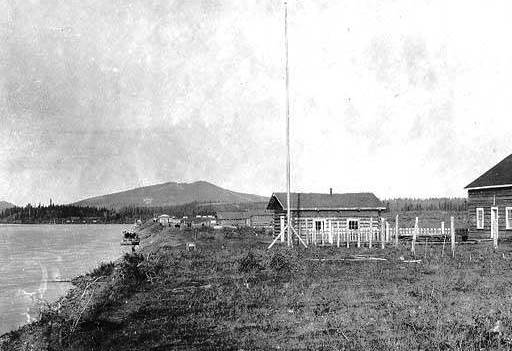
Fort Selkirk in 1898 when the Swineharts arrived , looking southeast upriver.
(Eric Hegg photo, University of Washington Libraries, Special Collections, Hegg 727A)

Shortly after landing at Fort Selkirk, Swinehart began to develop his farm. The land tenure situation for the farm is very intriguing, and continues so to this day. Earlier that year, on March 2, 1898, a man from Juneau named Frank Bach had submitted an application for one square mile (640 acres) of land at an unidentified location “in the vicinity of Fort Selkirk for an experimental farm”. Bach was a prominent businessman, a judge, and for a time the mayor at Douglas Island near Juneau.

Bach had gone to the Klondike at least as early as 1897 and must have come across this piece of land off the beaten path near Fort Selkirk that appealed to him.  He returned to Juneau in October 1897 with a group that included Jack Dalton who left Dawson because of warnings of a lean winter due to lack of provisions there. Mt. Bach near the Hutchi Lakes was named that year in his honor because he “helped Jack Dalton make the Dalton Trail through here to the Yukon River”. The nature of Bach’s relationship with Dalton and what assistance he provided him is not clear.

Frank Bach submitted his application for the Fort Selkirk land, likely from Juneau, at the same time that William Swinehart was preparing to leave there for the Yukon.  The two men must have had a fairly close relationship in Juneau, as Swinehart left his daughter Vivian there to live with the Bach family.

There is no record of what happened with Bach’s land application of March 1898, but it is clear that William Swinehart began developing his farm on the land that summer. He started living at the site on June 21, 1898, within a week of arriving at Fort Selkirk, so there seems little doubt that Bach told Swinehart about the parcel of land he had applied for and encouraged him to occupy it under some sort of arrangement.  Three years later, on July 18, 1901, Swinehart applied for 80 acres at this location west of Fort Selkirk “in lieu of [Bach’s application] of 2nd March 1898”. The story behind this substitution of land applications, as well as for the three-year gap between them, is not known.

In July 1902, Swinehart paid the balance of the purchase price for the land to the government, and in August the parcel called Lot 7 Group 4 was surveyed for him. Later that year, on November 26, 1902, a Dominion Lands Grant (title to the land) was issued, but surprisingly it was not to Swinehart.  For whatever reason, perhaps the agreement with Frank Bach, the title was issued to Bach, and Swinehart never owned the land he developed, lived on and farmed for 16 years, and died on.

The valley containing the Swinehart Farm has a trail from Fort Selkirk running through it that connects back up to the Yukon River about eight kilometers downstream from the settlement. It was part of the winter trail between the coast and the Klondike region before the Whitehorse-Dawson Overland Trail was in place. This trail became upgraded to a road to the Swinehart Farm and beyond, likely in 1899 to support the Yukon Telegraph line that was being built through to Dawson City. Rather than following along the Yukon River as it normally did, the telegraph line took an easier route west through the valley and across the newly-developing Swinehart Farm.

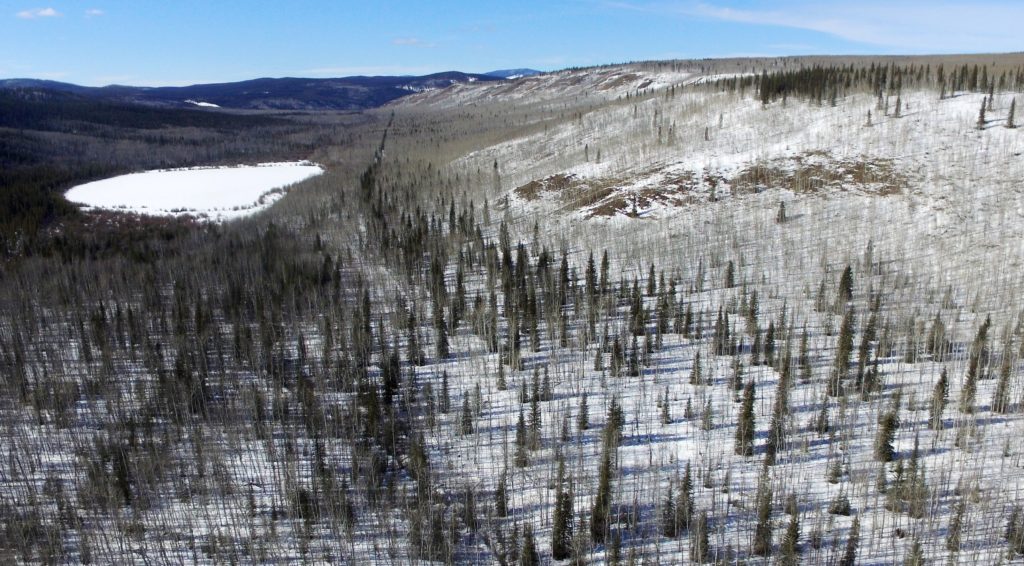
Swinehart Farm area in bottom half of photo, April 2017, looking west – road and telegraph line run through from bottom right corner and are marked by line of dark trees near upper center. Near lower center is the irrigation ditch.   
(©Neal Allison photo)

There is no known arrangement with Swinehart for the telegraph line crossing the farm land, and he had no land tenure to bargain with, but he may have welcomed the improved access as well as the clearing provided by it. When the Overland Trail from Whitehorse to Dawson City was built in 1902, it bypassed Fort Selkirk by several kilometers, but this route through the Swinehart Farm was surveyed out as a road allowance for what was called the Selkirk cut-off. This was a road to connect the community to the Overland Trail further to the north and across the Yukon River.

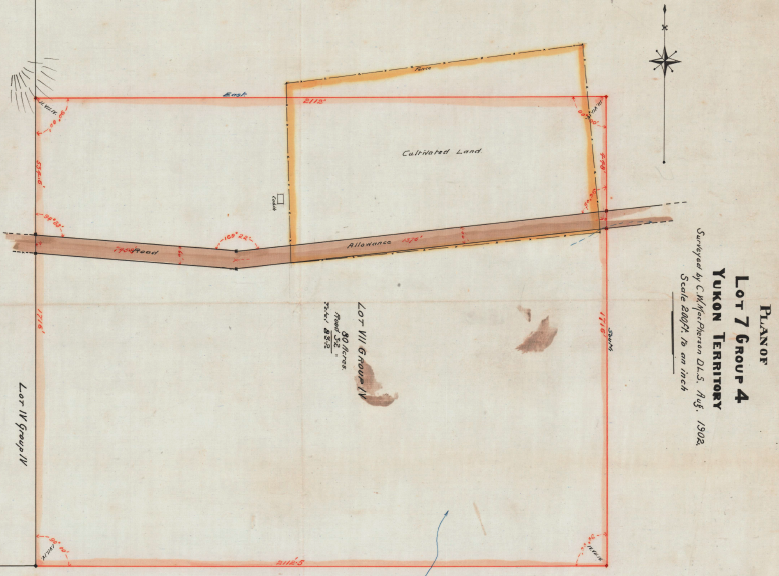
The 1902 survey plan for the Swinehart Farm property shows a cabin, the road allowance, and about 15 acres fenced and under cultivation, a portion of it off of the property. This field, though now completely overgrown, still shows up plainly against the surrounding vegetation on modern air photos. Therefore it appears that this may be the extent of the land that was ever developed for farming, even though other sources quote somewhat more acreage in production. Some of these sources also reference meadow land, so it is possible that a large meadow on an adjacent lot to the west was also used by Swinehart, perhaps for harvesting of wild hay.

Swinehart Farm survey plan – surveyed as Lot 7, Group 4 in 1902. The cleared and cultivated portion of land is outlined in yellow, and the house site is the small rectangle just to the left of it.                                                                    (Canada Lands Survey Records #9339)

The choice of this site three kilometers from the river for a farming endeavor might seem curious when almost all other such enterprises in the central Yukon are located beside the rivers. On a visit to the Swinehart Farm site with Dale Bradley, owner of the nearby Pelly River Ranch, his answer to this was immediate. The location had good soil, a nearby water source for irrigation, and good access to Fort Selkirk, where riverboats and winter stages could take the farm produce to markets in Dawson City and roadhouses on the Overland Trail. Equally or more important, the farm’s elevation likely provided a buffer from late spring and early fall frosts in the river valley bottom, a condition that Fort Selkirk was known to be susceptible to.

It is not known how much all four men, William and son Guy Swinehart along with William’s brother-in-law Ham Kline and William “Billy” Thompson, were involved in the establishment of the Swinehart Farm. Not a lot was produced at the farm as it was being developed and it wouldn’t have paid much during those early years, so some men appear to have taken on occasional other work. In 1899, Ham Kline was one of the first discoverers of gold on Nansen Creek west of Carmacks. Billy Thompson worked for a time during the gold rush piloting boats through Miles Canyon and the Whitehorse Rapids.

The Swinehart Farm must have held some attraction or allegiance, however, because three years after arriving in the Yukon all four men were there when the 1901 Canada Census was taken. While William was listed as the ‘head’ of the household and Guy as his son, Kline was listed as a partner, Thompson as an employee, and another man, 40-year old Frank Chapman from Kansas, also as an employee. Also present at the farm were William Swinehart’s two oldest daughters, Leta and Vivian, an interesting sub-plot to the story that will be explored later.

The involvement of Frank Chapman and Billy Thompson in the Swinehart Farm is an interesting side note because this led to further pioneer farming in the Yukon. Frank Chapman went on to own the well-known Pelly Farm (also known as Pelly River Ranch) with his partner Peter Oleson beginning around 1910, and is thought to be the primary early developer of that farm. Billy Thompson encouraged his younger sister Lura and her husband J.C. Wilkinson to join him in the Yukon, which they did in 1917. The Wilkinsons also later owned the Pelly Farm and, along with their two sons and daughter, became well-known trappers, hunting guides and river outfitters in addition to being farmers.

Updated October 7, 2023
Next:  Part 3 – A Going Concern (1902-1914)

The Swinehart Farm – part 1 (Introduction; From Wisconsin to the Yukon, 1896-98)

The Swinehart Farm – part 1

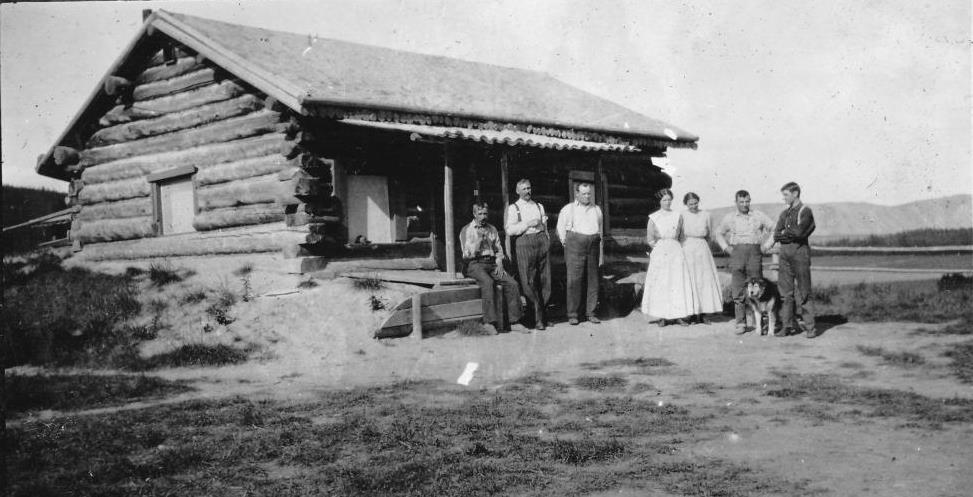
Swinehart family and others, farmhouse and field, ca. 1911
(Heather & David Ingrams collection)

Discovering the Swinehart Farm

There is a long-abandoned and overgrown farm in the bush near Fort Selkirk that seems to be little known and overlooked in Yukon history. It was a pioneer farming enterprise established by William Swinehart and his family during and following the Klondike gold rush. It operated for 16 years until Swinehart died while working in his field. He is buried at the Yukon Field Force cemetery at Fort Selkirk.

Some sources referred to Swinehart as “the pioneer farmer of the Yukon” and “the potato king of the Yukon”, titles that may ignore others who were doing similar things at the same time. Nevertheless, they are indicators of Swinehart’s status and role in early Yukon agriculture.

I have known of the Swinehart Farm for many years from my time spent with the Bradleys at Pelly River Ranch, but not much seemed to be known about it. Oral history projects conducted at Fort Selkirk in the 1980’s make it clear that the farm was known locally, but it is virtually absent from published reports on early Yukon agriculture. When I began researching the Swinehart Farm a few years ago, three very helpful things fell into place.

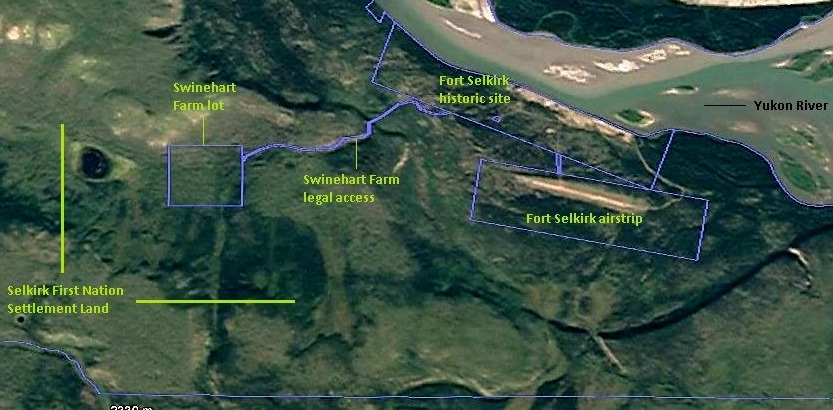
The first was finding the legal survey plan and field book for the farm property, which were dated August 3, 1902. The parcel was 80 acres and “surveyed for W.H. Swinehart”, leaving no doubt it was the right property and where it was located. A further look at the lot in greater context showed that it still exists, totally surrounded by Selkirk First Nation land except for a road right-of-way surveyed out to maintain legal access to the property. This meant the lot was perhaps still owned by somebody, and a little more digging confirmed it, an interesting situation that will be discussed later.

Swinehart Farm property near Fort Selkirk, Yukon
(Google Earth)

The second event was very fortuitous, when a lady in California named Susan Coltrin posted a query on Murray Lundberg’s ExploreNorth blog looking for information about the Swinehart Farm. Ms. Coltrin, a history teacher who was married to a Swinehart descendant, had a keen interest in the Swinehart Farm from both historical and genealogical perspectives. Thanks to Mr. Lundberg’s assistance, I was able to communicate directly with her, which resulted in an exchange of information about the farm and family, including historically valuable photographs.

The third good thing was making contact with Heather and David Ingrams of Ottawa, who are great-grandchildren of William Swinehart. They also provided valuable photographs of the Swinehart Farm, the Fort Selkirk area and other locations, as well as some additional family information.

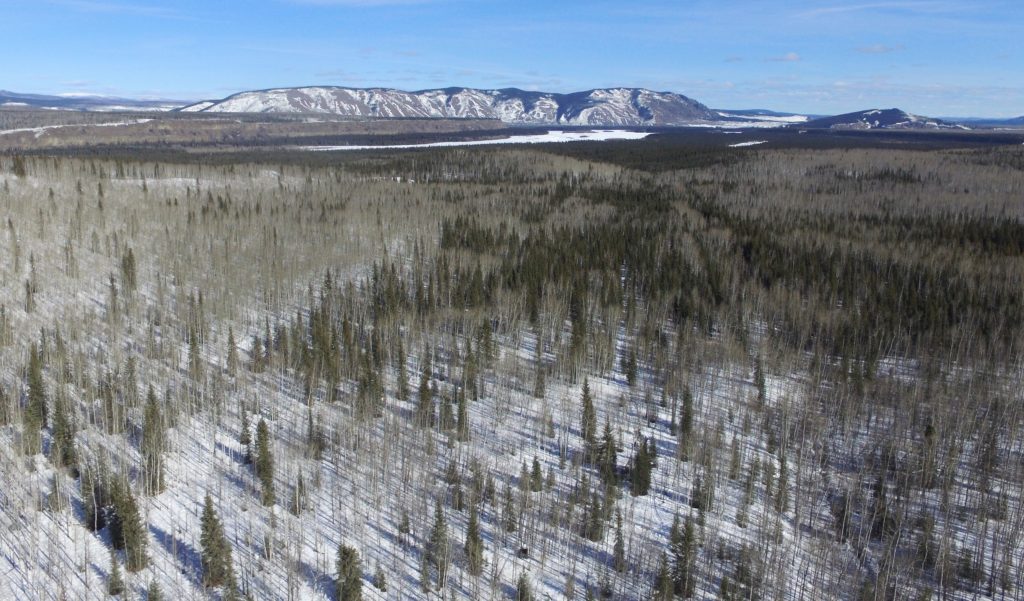
With these photos and information, things had lined up for a visit to the Swinehart Farm to learn what I could on site. I have been there several times, by three modes – walking, ATVing and snowmobiling. Two of the trips involved hauling a long ladder there to get into the tops of trees for views of the surrounding hillsides. This was to try to match up hill profiles that appeared in some of the old photos in order to prove that they are of the Swinehart Farm. A later trip to the farm involved the use of a drone, rendering the previous ladder efforts unnecessary and a little comical.

Swinehart Farm location in foreground, April 2017 – looking east toward Fort Selkirk and Yukon River. Dark object near bottom center is an outhouse, the only remaining structure.
(©Neal Allison photo)

I have to acknowledge the interest and efforts of Ron Chambers, Dale and Ken Bradley, and Neal Allison in accompanying and assisting me on the trips to the Swinehart Farm. I’m very grateful to have people like this willing to humor me in carrying out these ventures.

In addition to the on-the-land explorations, I have done archival, genealogical and other research to try to piece together tidbits of information to help tell the story of the Swinehart Farm. Here is the story as I have it so far.

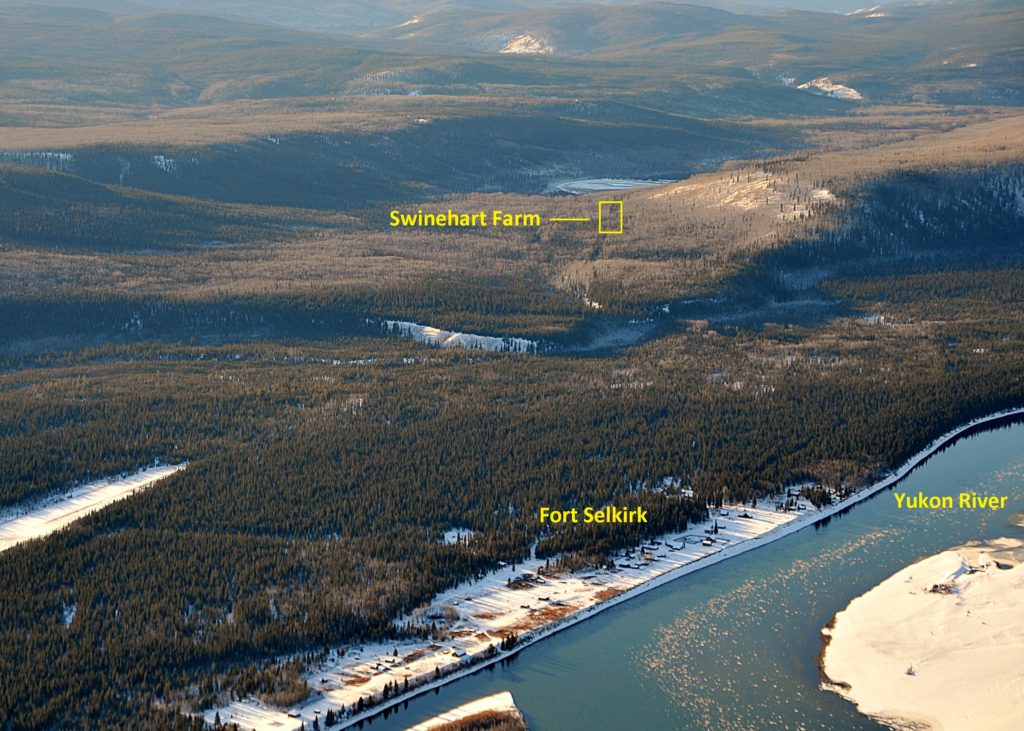
View west to location of Swinehart Farm, three kilometers from Fort Selkirk
(Yukon Government photo)

From Wisconsin to Alaska (1896 – 1898)

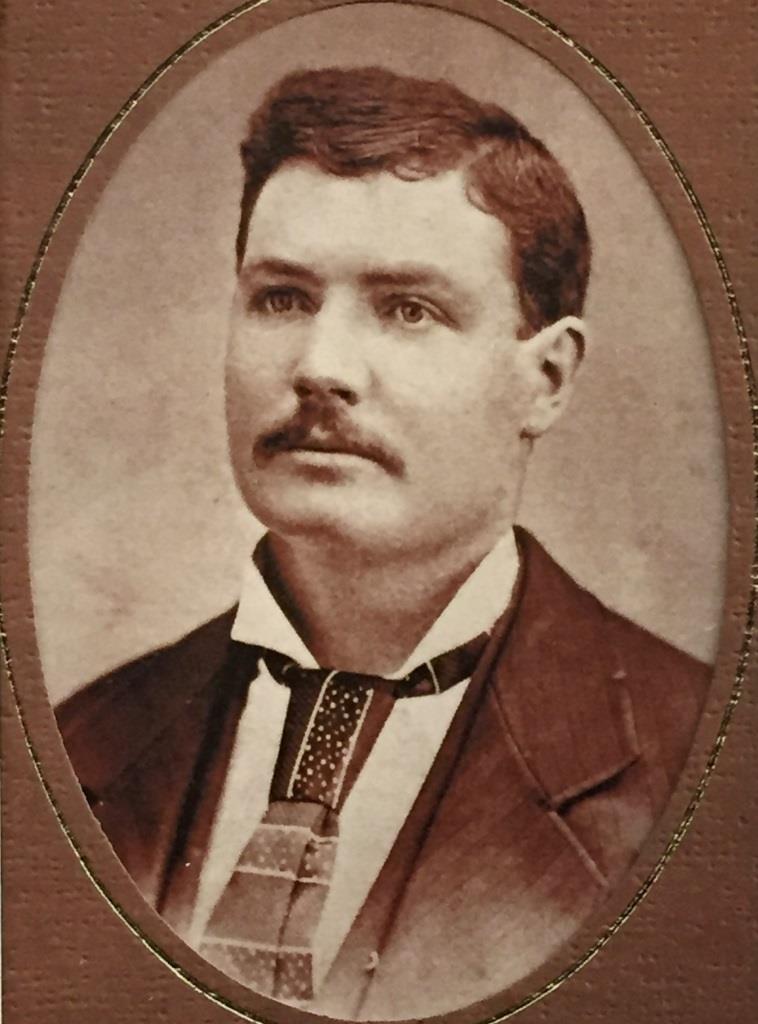
William Swinehart was born into a farming family in Wisconsin in 1855, but his early adult years did not foreshadow his future as a Yukon pioneer farmer. He attended a classical and musical academy, graduated from a business college, and became a bookkeeper and a county treasurer. By the late 1880’s William and his wife Rhoda had four children, a son and three daughters. Rhoda died in 1889 shortly after the birth of the last daughter, who was subsequently named Rhoda.

William Humphrey Swinehart, date unknown.
(provided by his great-grandson William Coltrin, June 2019)

In February 1896, William and Guy, his 14-year old son, left for Juneau, Alaska, leaving the three daughters behind in Wisconsin, likely in the care of their Swinehart grandparents. William went to Juneau to join his younger brother George, who was established there as editor and publisher of the Juneau Mining Record newspaper. Guy attended the Sisters of St. Ann School in Juneau for the 1896-97 school year.

Sometime within the next year and a half, William’s two oldest daughters, Leta and Vivian, at aged 17 and 12 respectively, came to Juneau and attended the Sisters of St. Ann School for the 1897-98 school year. Vivian remained in Juneau for the following two school years, but Leta returned to Wisconsin and rejoined her little sister Rhoda, who had been left alone with her grandparents.

In the summer of 1897, after boats loaded with Klondike gold arrived at Seattle and San Francisco, the gold rush was on. In Juneau, the brothers William and George Swinehart and William’s son Guy mobilized to head for the goldfields the following spring. They were joined at some point by two other men, a fellow Wisconsinite named William Thompson and Ham Kline, a brother-in-law of William Swinehart. The 1901 Canada Census shows them all arriving in the Yukon in April 1898 and still being together at Fort Selkirk three years later, so it is reasonable to assume they travelled into the Yukon together.

Into the Yukon (1898)

In the spring of 1898, the Swinehart entourage joined the gold rush horde along the Chilkoot Trail and into the Yukon. On April 3 they were at Sheep Camp on the Trail when deadly snowslides occurred that claimed around 60 lives. The Swinehart party made it as far as what is now known as Carcross before they had to wait for the ice to go out of the lakes.

While most gold rush stampeders were bringing mining-related equipment and supplies over the trail, the Juneau newspaper man George Swinehart brought printing equipment. While waiting for the ice to go out, he put out the one and only issue of the Caribou Sun on May 16, 1898, one of the earliest newspapers printed in the Yukon. When the lakes and Yukon River were open to travel, George headed for Dawson City rather than go to Fort Selkirk with the rest of his party. On June 11, 1898, he published one of the first Dawson newspapers, called the Yukon Midnight Sun.

Like his brother, William Swinehart apparently also brought equipment for a Klondike venture other than mining. In 1914, in a letter to his Wisconsin home town, he wrote this: “I came to Yukon in 1898 from Juneau, Alaska … with the big gold stampede of over 20,000 people on the trail at the same time. I claim distinction as being the only man in that big crowd who came for the purpose of farming. I had four horses, plows, harrows, seed potatoes, cultivators, and provisions for a year and a half. In fact, our party was quite a curiosity because we were not seeking gold.” It would have been a sight to see all this farm equipment and supplies being transported over the Chilkoot Pass and then on some sort of watercraft on the journey across the lakes and down the Yukon River.

A 1903 Yukon Sun newspaper article told it differently, that William Swinehart intended to go mining, but decided to venture into farming after seeing the prices being paid for hay, grains and garden produce in the Yukon. Where this information came from is not known, but whatever the case, when the Swinehart party arrived at Fort Selkirk on or about June 15, 1898, they stayed to pursue the agricultural possibilities they saw there. About three kilometers into the bush west of Fort Selkirk, they set to work clearing land, building a house and barn, and digging an irrigation ditch from a nearby drainage.

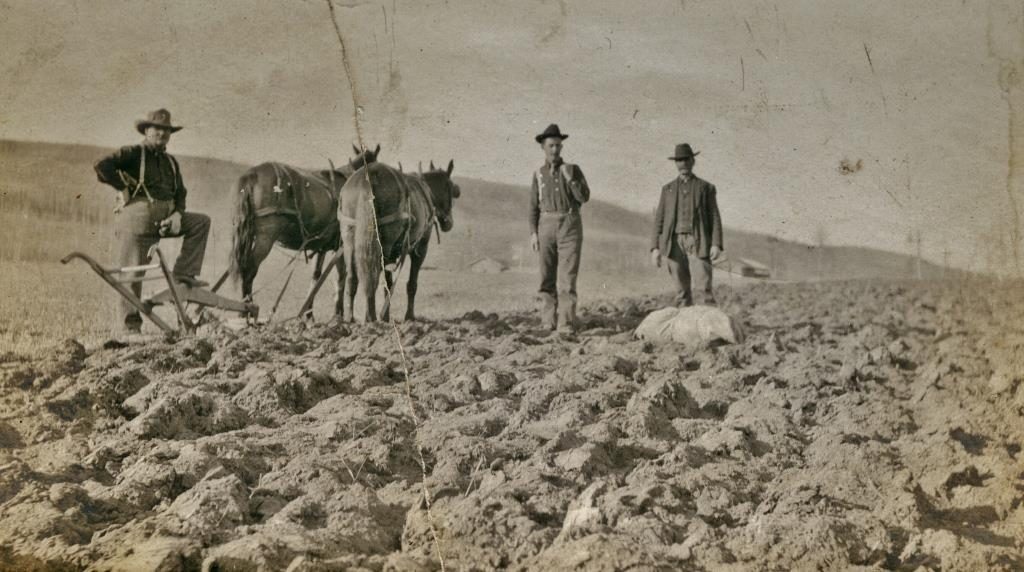
Ploughing land at the Swinehart Farm, early 1900’s
(Susan Coltrin collection)

Updated October 7, 2023

Next:  Part 2 – Establishing the Swinehart Farm (1898-1902)